Report on energy SYSTEMS PROJECT AT ELCT
Lugala Lutheran Hospital
1. Introduction.
Lugala Lutheran Hospital has been using wood, kerosene, diesel, liquefied petroleum gas and direct solar energy.
Underneath are details of fuel uses:
§ Wood is used for heating water in laundry.
§ Kerosene had been used for boiling medical instruments and equipment, cooking tea, patient room lighting and burning medical wastes.
§ Diesel is used for running diesel generators, vehicles, and the tractor.
§ Liquefied petroleum gas is used for sterilisation of infusion products and instruments.
§ Direct solar energy is used for water pre-heating and electricity production.
Till March 2002, Lugala Lutheran Hospital used paraffin lamps for patient room lights after 10pm, because the existing Central Solar Photovoltaic System, installed in 1997, was not able to meet the electricity demand. It was planned to change (add capacities) installations and reorganise energy use to overcome energy problems, at the same time reducing the costs of running the different systems. The tractor was made a self-running project since August 2002. The tractor is supplied with diesel from the free market.
Till August 2003 the power supply schedule during dry season and without night operations, was as in table 1.
|
Monday,
Wednesday, Friday, Saturday and Sunday March, 2002 – August, 2003 |
|||
|
Time From-to |
System |
Supplied
areas |
Comments |
|
Midnight-2am |
Central Solar Photovoltaic System |
OPD[1], fridges, workshop |
|
|
2am-8am |
No supply from Central Solar Photovoltaic System |
|
Power cut at 2am due to aged accumulators (misuse), see below 2.1 |
|
8am-645pm |
Central Solar Photovoltaic System |
Fridges, offices (computers), water pump and theatre. |
While the pump was working it used all electricity produced and accumulators were not charged. Electricity was not sufficient for air conditioner. |
|
645pm-10pm |
Diesel generator |
Supplies hospital and staff houses, charged accumulators[2] |
|
|
10pm-midnight |
Central Solar Photovoltaic System |
OPD, fridges and workshop |
|
|
10pm-6am |
Accumulators charged by diesel generator |
Light in OPD and all wards (until 7am in maternity unit) |
See below 3.3 |
|
Tuesday
and Thursday March, 2002 - August, 2003 |
|||
|
Midnight-2am |
Central Solar Photovoltaic System |
OPD, fridges, workshop |
|
|
2am-8am |
No supply from Central Solar Photovoltaic System |
|
Power cut at 2am due to aged accumulators (misuse), see below 2.1 |
|
8am-9am |
Central Solar Photovoltaic System |
Fridges, Offices (computers) |
|
|
9am-330pm |
Diesel generator |
Fridges, offices, water pump and theatre (including air conditioners and sterilizers) |
Tuesdays and Thursdays routine operations were done. |
|
330pm-645pm |
Central Solar Photovoltaic System |
Fridges and offices |
|
|
645pm-10pm |
Diesel generator |
Supplies hospital and staff houses, charged accumulators |
|
|
10pm-midnight |
Central Solar Photovoltaic System |
OPD, fridges and workshop |
|
|
10pm-6am |
Accumulators charged by diesel generator |
Light in OPD and all wards (until 7am in maternity unit) |
See below 3.3 |
Table 1:Power supply schedule at Lugala Lutheran Hospital March, 2002-August, 2003.
System operation:
§ Central Solar Photovoltaic System - about 13 hours/day on average
§ Diesel generator – about 5 hours/day on average
§ Accumulators charged by diesel generator – about 8 hours/day on average
Systems operation time sums up to more than 24hours per day, because in practice, systems overlap.
To date, the use of kerosene for boiling tea and for the sterilisation of equipment has been abandoned. The left over liquefied petroleum gas[3] from Infusion Unit is nowadays used for boiling tea and instruments.
2.0
General expense
The salary of our mechanic is not taken into account, because he is needed anyway. All allowances are charged to running cost of diesel generator.
Allowance per year 2002: TSh. 588 000
Allowance per year 2003:Jan-Aug TSh. 392 000
Sep-Dec TSh. 104 000
Projected allowance in 2004: TSh. 312 000
2.1 The Central Solar Photovoltaic System.
The Central Solar Photovoltaic System had accumulators with depleted capacity due to deep discharge (misuse).
In July 03 new 2V 700Ah * 24 accumulators were installed. In August, 2003 20 used panels (from the old water pumping system, which could not be used because the special converter was broken and could not be replaced) were added to the Central Solar Photovoltaic System. The capacity was increased from 3080Wp to 4180Wp. The increase of capacity made the use of both the water pump and the air conditioner in the theatre possible during daytime. In addition, it is now possible to operate at night without switching on a generator provided there was sunshine during daytime.
Early November, 03 timer switches were installed to control the energy consumption so that the reliability of the electrical supply to the theatre is increased. The timers were installed to the following equipment/places:
§ Fridge in the pharmacy (70W) On/off 0830/1130Hrs 1330/1530Hrs 1930/2130Hrs
§ Fan to cool radio (20W) On/Off 1200/2130Hrs
§ Water pump (1000W) On/Off 1000/1400Hrs 1930/2130Hrs
§ Photocopy machine (1300W) On/Off 1100/1300Hrs 1930/2130Hrs
§
Lab sockets, eliminating day supply
from Central Solar Photovoltaic System so that lab can use its island system
during a day time On/Off 2130/0800Hrs
In November 03 one panel was added to the Solar Photovoltaic System charging radio accumulators. The extra panel increased the capacity of the system from 55W to 110W. The conventional charger was disconnected from the Central Solar Photovoltaic System.
In December 03 all sockets in the wards, except one controlled socket in the labour room, were disconnected from the Central Solar Photovoltaic System as a measure of combating misuse of the system.
Investment
§ Purchase of complete system in 1997 and associated transport costs
Hamburg – Dar-es-Salaam (Nord-Süd Brücken DM 39 790.5 DM=TSh 350) TSh. 13 926 675
§ Purchase of new accumulators and associated transport costs
Hamburg – Dar-es-Salaam (KPS € 19565 1€ = TSh. 950)= 24 accumulators TSh. 14 786 750
§ Port clearing charges TSh. 696 000
§ Transport Dar-Es-Salaam - Lugala TSH. 720 000
§ Organisation of equipment collection in Dar es Salaam TSh. 194 800
§ Casual labour TSh. 20 000
§ Timer switches 6pce TSh. 244 800
§ Various installation materials TSh. 2 040 700
TSh.32 629 725
Running costs
§ Unionised water TSh. 2 000
§
Panel frame repair TSh. 22 500
TSh. 24
500
2.2
Laboratory Solar Photovoltaic System.
In July 03 the defect inverter of capacity 24/220-240V/600W was replaced. The system is used for powering the fridge, microscopes and lighting. 12 old accumulators from the Central Solar Photovoltaic System were installed to replace the defect accumulators in the laboratory. October 03 two new panels were added to expand the Solar Photovoltaic System.
Investment.
§ New Inverter SWR 600
§ 2 new panels (included in 2.1 above)
Running
costs.
§ Unionised water TSh. 2000
2.3
Solar Water Heater 12m²
The water heaters at the laundry were improved by replacing an automatic water valve, by the replacement of wood frames, broken glasses and by painting the water tank sheath black.
The improvement of the solar water heaters was carried out in order to increase its heating efficiency, thus reducing the use of firewood.
Investment
§ Structural materials (included in 2,1 above)
2.4
Solar Photovoltaic System at Ngalimila Dispensary
In Dec 2003, the Solar Photovoltaic System was installed at Ngalimila. The system has been designed to provide electricity at Ngalimila dispensary for lighting and a microscope. District Medical Officer of Kilombero District has offered a multi - fuel fridge to Ngalimila. The fridge can be powered by electricity (12Vdc or 220Vac), Liquefied Petroleum Gas (LPG) or Kerosene. At the moment district council of Kilombero District supplies Ngalimila with LPG.
3.0 Diesel Generator
3.1 Diesel generator: 2002
Investment:(German
Embassy-Dar Es Salaam)
§ Purchase TSh. 9 500 000
§ Transport Dar-es-Salaam – Lugala TSH. 720 000
§ Organisation of equipment procurement.
§ Travel allowances 2 people
§ Project proposal submission to Germany Embassy TSh. 218 500
§ VAT exemption and ordering TSh. 167 000
§ Generator collection (allowance) TSh. 113 000
§
Casual labour TSh 86 000
TSh.10 804 500
Annual
running cost (2002)
§ Oil TSh. 179 000
§ Diesel + transport 8693 litres * TSh. 653/litre TSh 5 676 529
§ Spare parts TSh. 1 429 000
§
Unionised water TSh. 1 600
§
Allowance of the mechanic TSh 588 000
TSh. 7 874 129
3.2.0 Diesel
generator (2003).
Annual running cost
§ Allowance of the mechanic TSh. 496 000
§ Oil TSh. 3 000
§ Diesel-VAT exempted with transport 6613 litres * TSh. 599/litre TSh. 3 961 187
§ Spare parts TSh. 458 000
§
Unionised water TSh. 2 000
TSh. 4 920
187
3.3.0 Generator
charged battery light-system (KPS Support).
In March 2002 Lugala Lutheran Hospital installed a diesel generator charged accumulator light system (technically they are two systems, however, for the sake of this analysis we consider them as one). The system replaced paraffin lanterns. The system provides electricity for lighting of Male, Female, Paediatric and Maternity wards only (see table 1 above). The system is fixed with a timer switch, which switches on at 9.45pm and goes off at 6am. A separate line is provided to give one hour extra light (5.55am-7am) to a labour room in the maternity ward.
Investment
(2002)
§ Purchase and associated transport cost Hamburg – Dar Es Salaam TSh. 12 395 040
§ Port clearing charges TSh. 654 099
§ System transport Dar Es Salaam –Lugala TSH. 660 000
§ Allowance TSh. 88 000
§ Acidified water transport
Dar Es Salaam –Ifakara TSh. 32 000
Ifakara – Malinyi TSh. 187 500
TSh. 14 016 639
Running
cost per year (2003)
§ Unionised water TSh. 4 000
§ Diodised fuse (€ 3*5pce) TSh. 15 000
TSh. 19 000
4.0 Kerosene
(2002)
Running
cost
2000 TSh. 815 500
2001 TSh. 565 950 Saving 2000 to 2001 TSh. 249 550
2002 TSh. 387 715 Saving 2001 to 2002 TSh. 178 235
2003 TSh. 86 000 Saving 2002 to 2003 TSh. 301 715
5. Observations
and conclusion.
The improved performance of Solar Photovoltaic System at Lugala Lutheran Hospital can be described quantitatively and qualitatively.
Qualitative improvement.
The replacement of kerosene lanterns by electricity from accumulators charged by the diesel generator has improved the quality of service as medical staff can see well in the night, when they attend patients.
There is no problem of carbon particles polluting air and blackening walls, and danger of fire is reduced.
The installation of the 24 new accumulators and of 20 used panels to the Central Solar Photovoltaic System has increased the reliability of electricity for pumping water (10.00am-2.00pm). In addition, we can now offer the following services at any time:
§ taking X - Rays
§ using computers
§ dental care
§ operations in the theatre
§ taking examinations using microscopes and the Sonography machine.
Quantitative
improvement.
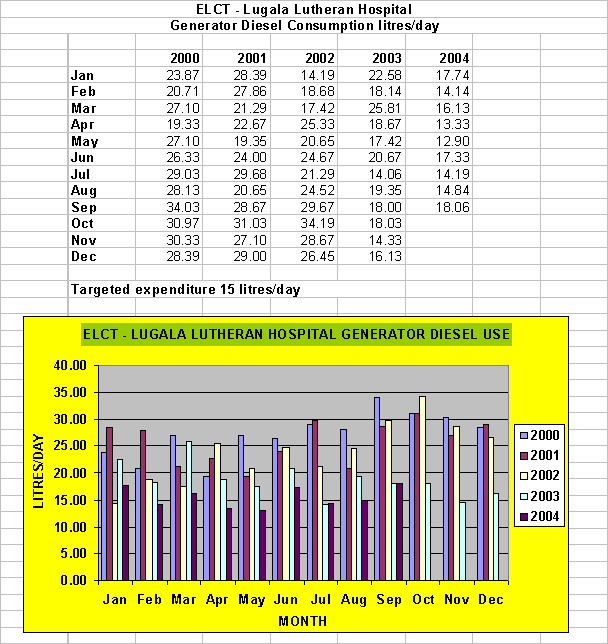
The increase of supply time and reliability of electricity from the Central Solar Photovoltaic System and a new arrangement of sterilisation in the theatre, has resulted in the reduction of diesel generator use time to the average of 3hours per day and increase to the Central Solar Photovoltaic System to 21 hours per day during the dry season. During the rainy season, there are days when it is necessary to run a diesel generator during daytime. The consumption of diesel for electricity generation has been reduced from 27.16 ltrs/day(2000) 25.79 ltrs/day (2001), 23.82 ltrs/day (2002), to 18.12 (2003), see appendices 1 and 2. The target is to reach the average diesel consumption of 15 litres/day in the year 2004. In terms of total diesel consumed for electricity production, the trend was 9913 ltrs in the year 2000, 9412 ltrs in the year 2001, 8693 ltrs in the year 2002 and 6613 ltrs in the year 2003. Thus, the fuel savings were as follows: 2000 to 2001 501 ltrs, 2001 to 2002 719 ltrs, 2002 to 2003
2080 ltrs The equivalent monetary saving was TSh. 1 715 342 in the year 2003, see figure 1.
|
Figure 1 |
Improvement done in the use of the energy
systems, affected also the kerosene consumption. By cutting down kerosene
expenditure used for lighting and sterilisation, there was a saving of TSh. 301 715.
After installation of 24 new accumulators and 20 used panels to the Central Solar Photovoltaic System, the on call schedule of the Mechanic was changed in Sept, 2003. He used to be on call during 3.30pm-7.30am on week days and 24hours on weekends/public holidays. He was paid a call allowance of TSh 1200/weekday and TSh. 2400/weekend or holiday. The overtime was rescheduled to 6.45pm-10pm on weekdays, and 10am-2pm (because of the water pump) and 6.45pm-10pm on weekends/holidays. The new call allowance is at the rate of
TSh. 600/weekday and TSh. 1200/weekend or holiday. The rescheduling of overtime of mechanic has resulted to a saving of TSh. 276000/year.
The purchase of a new generator and reduction in generator running time, has resulted in spare part cost savings of TSh. 971 000 in a year 2003.
There is still a need to expand the capacity of Central Solar Photovoltaic System to 6160Wp. In order to manage that 36 panels of the capacity 55Wp each are required. At the moment, it is hazardous to use an air conditioner (1000W) during operations during night time. The extra capacity will assure enough charging of accumulators.
Total investment for Solar Energy Systems (1997-2003) TSh. 32 629 725
Total investment for diesel generator + accumulators (2002) TSh. 24 821 139
Total running cost for Solar Photovoltaic Systems per year (2003) TSh. 26 500
Total running cost of diesel generator + accumulators per year (2003) TSh. 4 939 187
Savings made due performance improvement of the Energy Systems at Lugala Lutheran Hospital in 2003 were:
Diesel TSh. 1 715 342
Kerosene TSh. 301 715
Mechanic allowance TSh. 92 000
Spare part for diesel generator TSh. 971 000
TSh 3 080 057
The running costs of Solar Photovoltaic System is very low compared to that of diesel generator, but it is opposite to the investment costs. The Solar Photovoltaic System looks to be expensive as diesel generator does not pay environmental costs. Considering distance to the nearest possible grid connection point, solar systems are still appropriate at Lugala Lutheran Hospital than connecting to the national electricity grid, which could have cost
€ 1 242 000.
Comparing figures a little bit it seem that an investment of 32million TSh. brought an annual reduction of running to the tune of 3million. This means it would take 11 years to pay back the investment. However, taking into account the interest lost per year (1.6 million if the interest rate was 5%), the savings are only 1.4 million per year and it would take 23 years to pay back the investment... This obviously means when arguing for Solar Systems emphasis has to be placed on the resulting improvements in patient care and services. Monetary saving are simply not convincing at the present prices of solar equipment, however the improvement in services is obvious. Patients do not have to wait for X-rays anymore, the ultrasound equipment is available at any time. Water is now usually available in abundance.
We will be happy to share our experience with other people who would to solve the rural energy problem.
Eng. Matthew Matimbwi, RegEng(T)
Hospital Engineer
Lugala Lutheran Hospital
Confirmed
by:
Dr. Joerg Poennighaus
Medical Officer in Charge
Lugala Lutheran Hospital